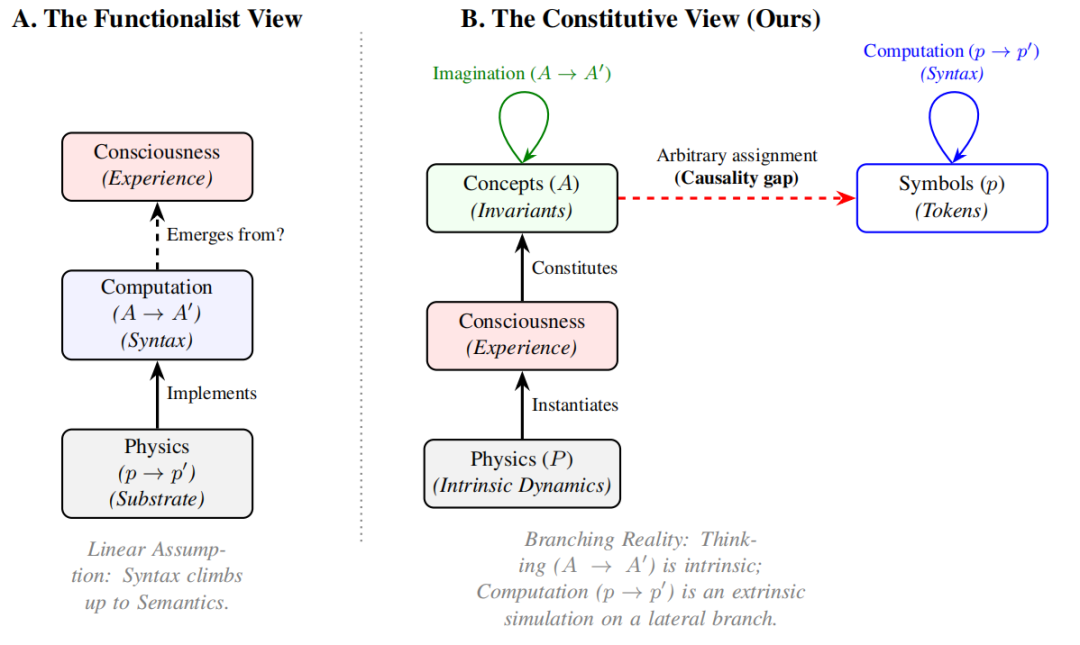
云栈社区关注到,计算功能主义将意识归因于抽象因果拓扑与算法结构,是当前 AI 意识议题的主流立场。Google DeepMind 的这篇文章提出抽象谬误核心批判,指出符号计算并非内在物理过程,而是依赖具备主观体验的制图者进行语义编码的描述工具,从本体论层面严格区分模拟与实例化,证明算法符号操作无法生成主观意识。意识源于特定物理构成与热力学动态,而非载体无关的句法架构。该框架为驳斥计算功能主义、厘清 AI 感知能力边界提供了物理主义支撑,也为 AI 安全与伦理讨论破除福利陷阱。
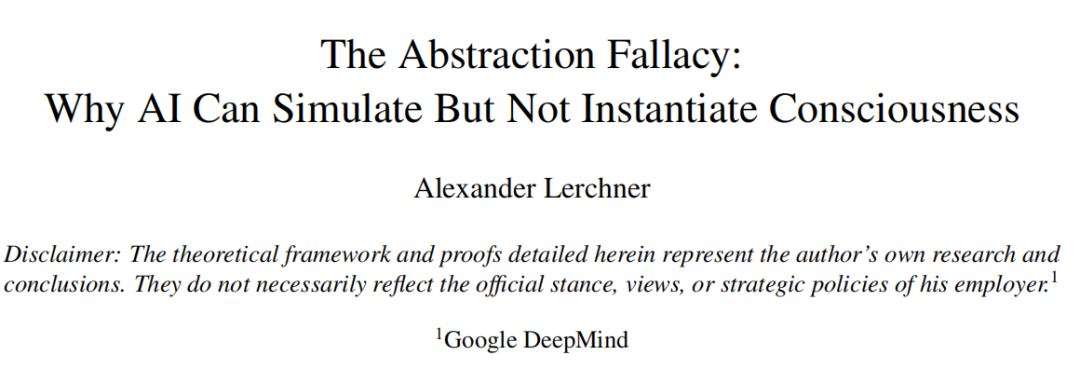
论文题目:The Abstraction Fallacy: Why AI Can Simulate But Not Instantiate Consciousness 论文链接:https://philarchive.org/archive/LERTAF 发表时间:2026年3月19日 论文来源:Google DeepMind
1. 引言
大语言模型在实践中取得的成功,已将意识的困难问题从纯理论领域推向工程与政策领域。随着算力规模化带来巨大收益,主流功能主义范式认为,只要实现恰当的信息处理功能,就足以产生现象意识。在这一视角下,算法的表征属性被视为感知能力的潜在证据,正是这一假设推动了近期关于 AI 福利与道德主体地位的严肃提案。顶尖理论家进一步强化了这一转向,他们认为现有顶尖模型在未来十年内很可能拥有真实的主观体验。
换言之,算法复杂度产生意识的主张犯了本体论倒置错误,将句法当作内在动力学的实在本身,假定制图者可以由地图生成。通过区分外在行为模拟与内在物理实例化的结构分离,本文证明数字架构不可能成为道德主体,这一认识将 AI 安全领域从福利陷阱中解放出来,让我们专注于拟人化的具体风险,将通用 AI 视为强大但本质无感知的工具。
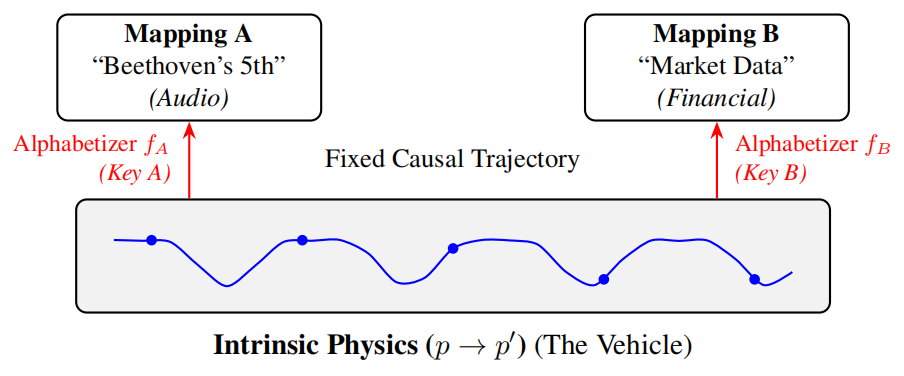
即使未来的 AI 系统完全采用全模拟神经形态芯片并摒弃浮点运算,本体论上的鸿沟依然存在。一旦某种物理状态无论是离散的电压水平还是连续的电荷模式被认定为读出信号或隐藏状态,它就已经被映射生成者进行了字母排序。因此,这些模型始终被语义屏障所封闭。尽管它们能够构建复杂的内部映射,却缺乏与经验物理领域之间内在的、本质性的联系。
在确认算法复杂性与物理实现均无法跨越因果性鸿沟后,我们现在可以探讨该框架的实际意义。计算映射与物理领域之间的结构性分离对 AI 安全性具有直接启示:它有助于明确哪些系统能够真正支持现象体验,哪些则不能。具身化理论与具身认知的研究已指出若干与意识体验密切相关的物理过程,包括生命系统内的自创生机制及持续热力学调节。传统观点将这些机制视为生物体的固有属性,因而认为它们仅存在于碳基生命体中。
然而,在如此大规模实现行为模拟,对认知卫生提出了新的要求。AI 系统正迅速提升复制人类与其他意识主体相关联的行为信号的能力,这一趋势随着人形机器人等具身化系统的出现将愈发显著。这对科学界构成了明确挑战:我们不应仅仅为机器的权利做准备,而需要清晰界定模拟主体性与真实主体物理具现之间的方法论边界。因此,任何关于 AI 具有感知能力的主张,都必须经过严格的物理主义验证,验证依据不应是算法复杂性,而应是实现体验体验所需的特定内在物理动力机制。
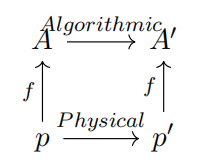
此外,我们指出:计算本质上是一种描述方式,一种映射关系,它无法在物理层面具体实现其所描述的对象。这些见解既挑战了关于主观体验本质的普遍认知,也挑战了关于计算本质的传统理解,其依据完全基于成熟的物理定律和严谨的逻辑推演。至关重要的是,与大多数关于意识 AI 潜力的讨论和推测不同,这一框架并不依赖于完整的意识理论。它通过探讨等式另一端的问题,即从本体论角度而言,计算究竟是什么,来解决这一看似棘手的难题。关于意识问题,该框架仅要求现象体验不违反因果封闭性原则,这是科学认知中最基本的原则之一。仅凭这一原则就足以证明:体验必然是由物理因素构成的、完全物理性的现象,从而让我们能够规避任何形式的二元论或表象论的推测。
总结我们建立的本体论:计算是对离散符号进行的句法操作,这些符号遵循旨在模拟概念思维的规则。这些符号并非概念的精炼本质,而是地图制作者随意分配的物理符号。而概念本身则是从实际生活及热力学经验中主动提取出的物理不变量。因此,期望算法描述能体现其所映射的特性,就如同期望引力的数学公式能在物理上产生重量一样不切实际。认为 AI 仅通过操纵内部变量就能获得意识,这正是盲点谬误的体现,即把地图误认为实际地形。
通过开发日益强大的 AI,我们并非在创造一种新的生命形式,而是在构建日益精确的预测模型。然而,无论其预测精度如何、作为推理工具的实用性如何,或其物理形态如何,这一 AI 系统本质上始终是与现象经验的领域截然不同。认识到这一区别,并避免本体论上的抽象谬误倒置,是建立一门成熟且基于物理原理的机器智能科学的前提。
参考文献
Attwell, D., & Laughlin, S. B. (2001). An energy budget for signaling in the grey matter of the brain. Journal of Cerebral Blood Flow and Metabolism, 21(10), 1133–1145.
Bengio, Y., Hinton, G., Yao, A., Song, D., Abbeel, P., Darrell, T., Harari, Y. N., Zhang, Y.-Q., Xue, L., Shalev-Shwartz, S., Hadfield, G., Clune, J., Maharaj, T., Hutter, F., Baydin, A. G., McIlraith, S., Gao, Q., Acharya, A., Krueger, D., et al. (2024). Managing extreme AI risks amid rapid progress. Science, 384(6698), 842–845.
Bennett, C. H. (1982). The thermodynamics of computation-a review. International Journal of Theoretical Physics, 21(12), 905–940.
Block, N. (1978). Troubles with functionalism. Minnesota Studies in the Philosophy of Science, 9, 261–325.
Block, N. (2025). Can only meat machines be conscious? Trends in Cognitive Sciences.
Bostrom, N. (2014). Superintelligence: Paths, Dangers, Strategies. Oxford University Press.
Bubeck, S., Chandrasekaran, V., Eldan, R., Gehrke, J., Horvitz, E., Kamar, E., Lee, P., Lee, Y. T., Li, Y., Lundberg, S., Nori, H., Palangi, H., Ribeiro, M. T., & Zhang, Y. (2023). Sparks of Artificial General Intelligence: Early experiments with GPT-4. arXiv [cs.CL].
Buzsáki, G. (2019). The brain from inside out. Oxford University Press.
Butlin, P., Long, R., Elmoznino, E., Bengio, Y., Birch, J., Constant, A., Deane, G., Fleming, S. M., Frith, C., Ji, X., Kanai, R., Klein, C., Lindsay, G., Michel, M., Mudrik, L., Peters, M. A. K., Schwitzgebel, E., Simon, J., & VanRullen, R. (2023). Consciousness in Artificial Intelligence: Insights from the Science of Consciousness. arXiv preprint arXiv:2308.08708.
Cao, R. (2012). A teleosemantic approach to information in the brain. Biology & Philosophy, 27, 49–71.
Chalmers, D. J. (1996). The Conscious Mind. Oxford University Press.
Chalmers, D. J. (2023). Could a Large Language Model be Conscious? arXiv preprint arXiv:2303.07103.
Craver, C. F. (2007). Explaining the Brain: Mechanisms and the Mosaic Unity of Neuroscience. Oxford University Press.
Damasio, A. (1999). The feeling of what happens: Body and emotion in the making of consciousness. Harcourt Brace.
Dehaene, S., Lau, H., & Kouider, S. (2017). What is consciousness, and could machines have it? Science, 358(6362), 486–492.
Dennett, D. C. (1991). Consciousness explained. Little, Brown and Co.
Frank, A., Gleiser, M., & Thompson, E. (2025). The Blind Spot: Why Science Cannot Ignore Human Experience. MIT Press.
Friston, K. (2010). The free-energy principle: a unified brain theory? Nature Reviews Neuroscience, 11(2), 127–138.
Harnad, S. (1990). The symbol grounding problem. Physica D: Nonlinear Phenomena, 42(1), 335–346.
Hoffmann, J., Borgeaud, S., Mensch, A., Buchatskaya, E., Cai, T., Rutherford, E., de L. Casas, D., Hendricks, L. A., Welbl, J., Clark, A., Hennigan, T., Noland, E., Millican, K., van den Driessche, G., Damoc, B., Guy, A., Osindero, S., Simonyan, K., Elsen, E., et al. (2022). Training Compute-Optimal Large Language Models. arXiv [cs.CL].
Husserl, E. (1970). The crisis of European sciences and transcendental phenomenology. Evanston: Northwestern University Press.
Kaplan, J., McCandlish, S., Henighan, T., Brown, T. B., Chess, B., Child, R., Gray, S., Radford, A., Wu, J., & Amodei, D. (2020). Scaling laws for neural language models. arXiv [cs.LG].
Kim, J. (2005). Physicalism, or Something Near Enough. Princeton University Press.
Landauer, R. (1961). Irreversibility and heat generation in the computing process. IBM Journal of Research and Development, 5(3), 183–191.
Laughlin, S. B., de Ruyter van Steveninck, R. R., & Anderson, J. C. (1998). The metabolic cost of neural information. Nature Neuroscience, 1(1), 36–41.
Laukkonen, R. E., Friston, K., & Chandaria, S. (2025). A Beautiful Loop: An Active Inference Theory of Consciousness. PsyArXiv.
LeCun, Y. (2022). A path towards autonomous machine intelligence. OpenReview.
Long, R., Sebo, J., Butlin, P., Finlinson, K., Fish, K., Harding, J., Pfau, J., Sims, T., Birch, J., & Chalmers, D. (2024). Taking AI welfare seriously. arXiv preprint arXiv:2411.00986.
Maturana, H. R., & Varela, F. J. (1980). Autopoiesis and Cognition: The Realization of the Living. D. Reidel.
McClelland, J. L., Rumelhart, D. E., & PDP Research Group. (1987). Parallel distributed processing (Vol. 2). MIT Press.
Nagel, T. (1974). What is it like to be a bat? The Philosophical Review, 83(4), 435–450.
Piccinini, G. (2008). Computation without Representation. Philosophical Studies, 137(2), 205–241.
Putnam, H. (1988). Representation and Reality. The MIT Press.
Schneider, S. (2019). Artificial You: AI and the Future of Your Mind. Princeton University Press.
Searle, J. R. (1980). Minds, brains, and programs. The Behavioral and Brain Sciences, 3(3), 417–457.
Seth, A. K. (2025). Conscious artificial intelligence and biological naturalism. The Behavioral and Brain Sciences, 1–42.
Sprevak, M. (2018). Triviality arguments about computational implementation. In The Routledge Handbook of the Computational Mind (pp. 175–191). Routledge.
Sutton, R. (2019). The Bitter Lesson.
Tegmark, M. (2008). The Mathematical Universe. Foundations of Physics, 38(2), 101–150.
Thompson, E. (2007). Mind in Life: Biology, Phenomenology, and the Sciences of Mind. Harvard University Press.
Wheeler, J. A. (1990). Information, Physics, Quantum: The Search for Links. In W. H. Zurek (Ed.), Complexity, Entropy, and the Physics of Information (pp. 3–20). Addison-Wesley.
 发表于 2026-4-30 18:55:33
|
查看: 264|
回复: 0
发表于 2026-4-30 18:55:33
|
查看: 264|
回复: 0