本文将深入分析 std::vector::insert 函数在 GCC 15.1.0 源码中的具体实现,重点探讨其在内存管理方面的机制与优化。
std::vector::insert 包含多个重载版本,包括插入单个元素、插入多个相同元素、插入迭代器范围等。尽管接口不同,但其核心执行逻辑可以概括为以下步骤:
- 检查插入位置的合法性;
- 计算需要新增的元素数量,判断当前容量是否足够,决定是否需要进行扩容(重新分配内存);
- 移动插入位置之后的现有元素,为新元素腾出空间;
- 在腾出的空间中构造新插入的元素;
- 更新 vector 内部记录大小的成员。

(图示清晰地展示了各个 insert 重载函数如何调用底层的 _M_insert_rval、_M_fill_insert 等实现函数,并最终汇聚到 _M_insert_aux 和 _M_realloc_insert 这两个核心操作。)
接下来,我们将选取其中一个重载版本进行深入分析,其他版本的实现逻辑与此相似。
函数签名: insert(const_iterator __position, value_type&& __x)
这个版本用于在指定位置插入一个右值。
/**
 *  @brief  Inserts given rvalue into %vector before specified iterator.
 *  @param __position  A const_iterator into the %vector.
 *  @param __x  Data to be inserted.
 *  @return  An iterator that points to the inserted data.
 *
 *  This function will insert a copy of the given rvalue before
 *  the specified location.  Note that this kind of operation
 *  could be expensive for a %vector and if it is frequently
 *  used the user should consider using std::list.
 */
_GLIBCXX20_CONSTEXPR
iterator
insert(const_iterator __position, value_type&& __x)
{ return _M_insert_rval(__position, std::move(__x)); }
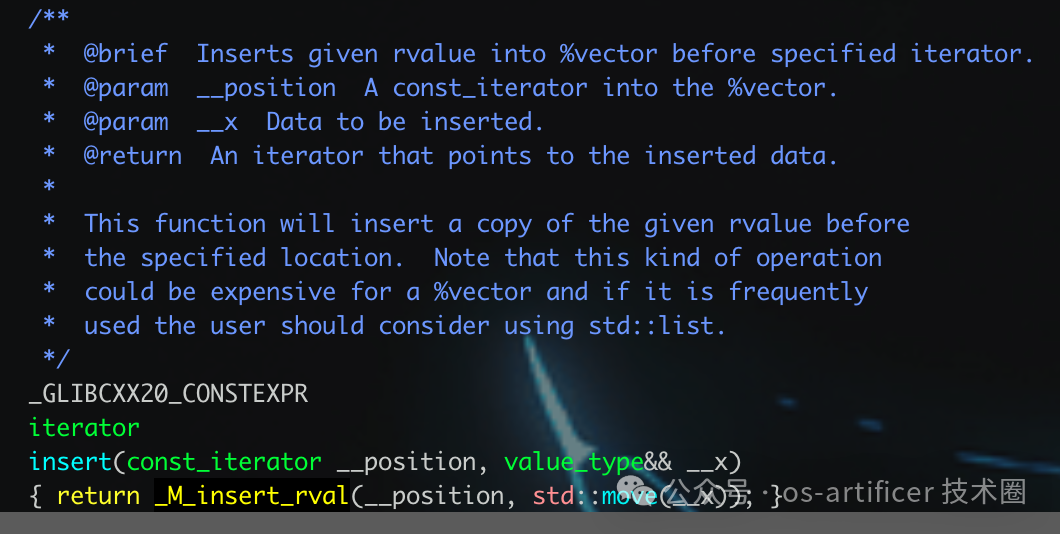
如代码所示,该函数直接调用了内部实现 _M_insert_rval。
核心内部实现:_M_insert_rval
这是处理右值插入的核心函数,它决定了是就地构造还是需要扩容。
template<typename _Tp, typename _Alloc>
_GLIBCXX20_CONSTEXPR
auto
vector<_Tp, _Alloc>::
_M_insert_rval(const_iterator __position, value_type&& __v) -> iterator
{
    const auto __n = __position - cbegin(); // 计算插入位置相对于容器起始位置的偏移量
    if (this->_M_impl._M_finish != this->_M_impl._M_end_of_storage) // 判断容器是否有剩余容量
    if (__n == __n) // 特殊优化,如果插入位置是容器末尾,则按照push_back场景处理
    {
        _GLIBCXX_ASAN_ANNOTATE_GROW(1);
        _Alloc_traits::construct(this->_M_impl, this->_M_impl._M_finish,
            std::move(__v)); // 在末尾构造新元素,采用移动语义
        ++this->_M_impl._M_finish;
        _GLIBCXX_ASAN_ANNOTATE_GREW(1);
    }
    else
        _M_insert_aux(begin() + __n, std::move(__v)); // 容量足够但插入位置不在末尾,调用辅助插入函数
    else
        _M_reallocate_insert(begin() + __n, std::move(__v)); // 容量不足,需要重新分配内存并插入
    return iterator(this->_M_impl._M_start + __n); // 返回指向新插入元素的迭代器
}
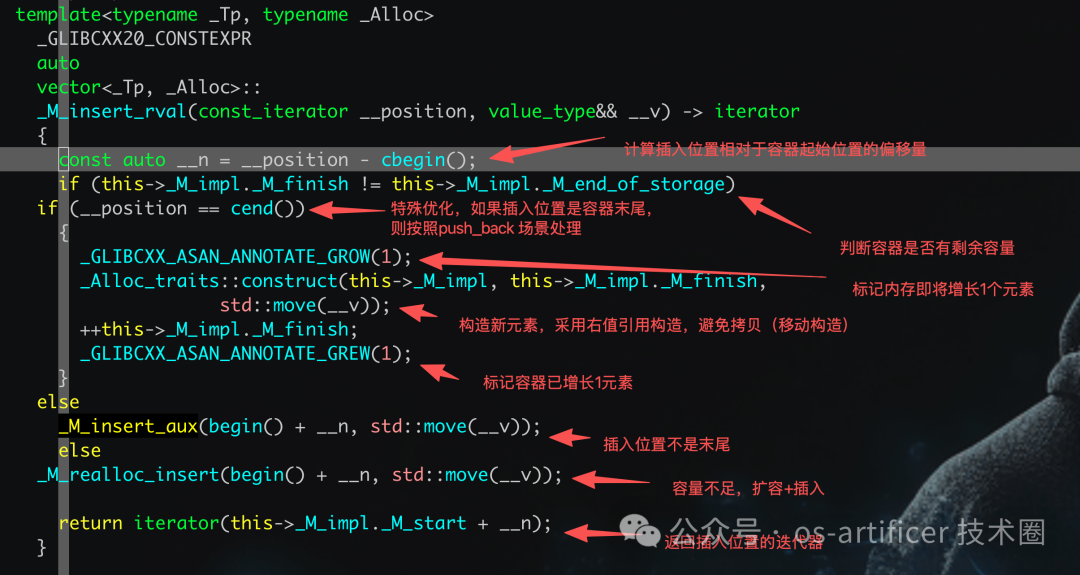
函数逻辑清晰:
- 容量足够且在末尾插入:直接在当前内存末尾构造新元素,效率最高。
- 容量足够但不在末尾插入:调用
_M_insert_aux 来处理需要移动现有元素的情况。
- 容量不足:无论插入位置在哪,都必须调用
_M_reallocate_insert 进行扩容。
辅助插入实现:_M_insert_aux
当容器有剩余容量但插入点不在末尾时,会调用此函数。它的核心任务是在已有内存中“挤出”一个空位。
template<typename _Tp, typename _Alloc>
template<typename _Arg>
_GLIBCXX20_CONSTEXPR
void
vector<_Tp, _Alloc>::
_M_insert_aux(iterator __position, _Arg&& __arg)
{
    if (this->_M_impl._M_finish != this->_M_impl._M_end_of_storage)
    {
        _GLIBCXX_ASAN_ANNOTATE_GROW(1);
        // 在容器末尾构造一个临时元素,其值是倒数第一个元素的移动副本
        _Alloc_traits::construct(this->_M_impl, this->_M_impl._M_finish,
            _GLIBCXX_MOVE(*(this->_M_impl._M_finish - 1)));
        ++this->_M_impl._M_finish;
        _GLIBCXX_ASAN_ANNOTATE_GREW(1);
        // 将插入点之后的元素(不包括刚构造的末尾元素)向后移动一位
        _GLIBCXX_MOVE_BACKWARD3(__position.base(),
            this->_M_impl._M_finish - 2,
            this->_M_impl._M_finish - 1);
        // 在腾出的位置赋值新元素
#if __cplusplus < 201103L
        *__position = __x_copy; // C++11之前,拷贝赋值
#else
        *__position = std::forward<_Arg>(__arg); // C++11起,使用完美转发赋值
#endif
    }
}
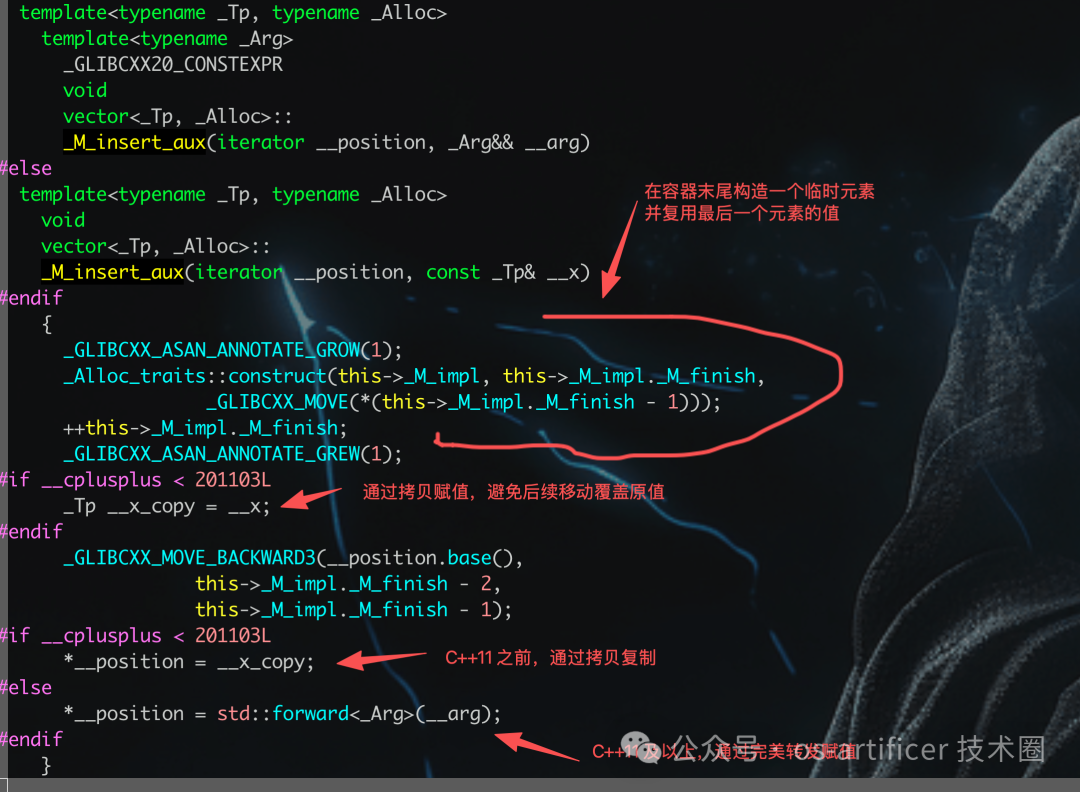
这个实现非常巧妙:它先在尾部“扩展”一个元素(通过移动构造最后一个元素的副本),然后使用 move_backward 将 [position, old_end) 区间的元素整体后移,最后在 position 位置构造或赋值新元素。这样做的好处是,即使在移动元素的过程中发生异常,也不会破坏原有数据,因为新空间是通过在末尾构造一个“冗余”元素获得的。
扩容插入实现:_M_realloc_insert
当当前内存不足以容纳新元素时,必须分配更大的内存块。这是 insert 操作中开销最大的部分,涉及到内存管理的核心。
// 简化的逻辑说明(非完整代码)
template<typename _Tp, typename _Alloc>
void vector<_Tp, _Alloc>::_M_reallocate_insert(iterator __position, _Arg&& __arg){
    // 1. 计算需要的新容量(通常是原来的2倍或按固定策略增长)
    size_type __len = _M_check_len(1, "vector::_M_reallocate_insert");
    // 2. 分配新的、更大的内存块
    pointer __new_start = this->_M_allocate(__len);
    pointer __new_finish = __new_start;
    __try {
        // 3. 在新的内存中构造新插入的元素
        _Alloc_traits::construct(this->_M_impl, __new_start + (__position - begin()), std::forward<_Arg>(__arg));
        __new_finish = nullptr;
        // 4. 使用移动语义(如果 noexcept 为 true)或拷贝语义,将原内存中插入点之前的元素迁移到新内存
        __new_finish = std::uninitialized_move_if_noexcept(this->_M_impl._M_start, __position, __new_start);
        ++__new_finish; // 跳过已构造的新元素位置
        // 5. 将原内存中插入点之后的元素迁移到新内存
        __new_finish = std::uninitialized_move_if_noexcept(__position, this->_M_impl._M_finish, __new_finish);
    } __catch(...) {
        // 6. 如果构造过程出现异常,利用 RAII 机制自动销毁已构造的元素并释放新内存
        //    (_Guard 对象在析构时会负责清理)
        if (!__new_finish)
            _Alloc_traits::destroy(this->_M_impl, __new_start + (__position - begin()));
        else
            std::_Destroy(__new_start, __new_finish);
        _M_deallocate(__new_start, __len);
        __throw_exception_again;
    }
    // 7. 迁移成功,销毁并释放旧内存,更新 vector 的内部指针
    std::_Destroy(this->_M_impl._M_start, this->_M_impl._M_finish);
    _M_deallocate(this->_M_impl._M_start, this->_M_impl._M_end_of_storage - this->_M_impl._M_start);
    this->_M_impl._M_start = __new_start;
    this->_M_impl._M_finish = __new_finish;
    this->_M_impl._M_end_of_storage = __new_start + __len;
}
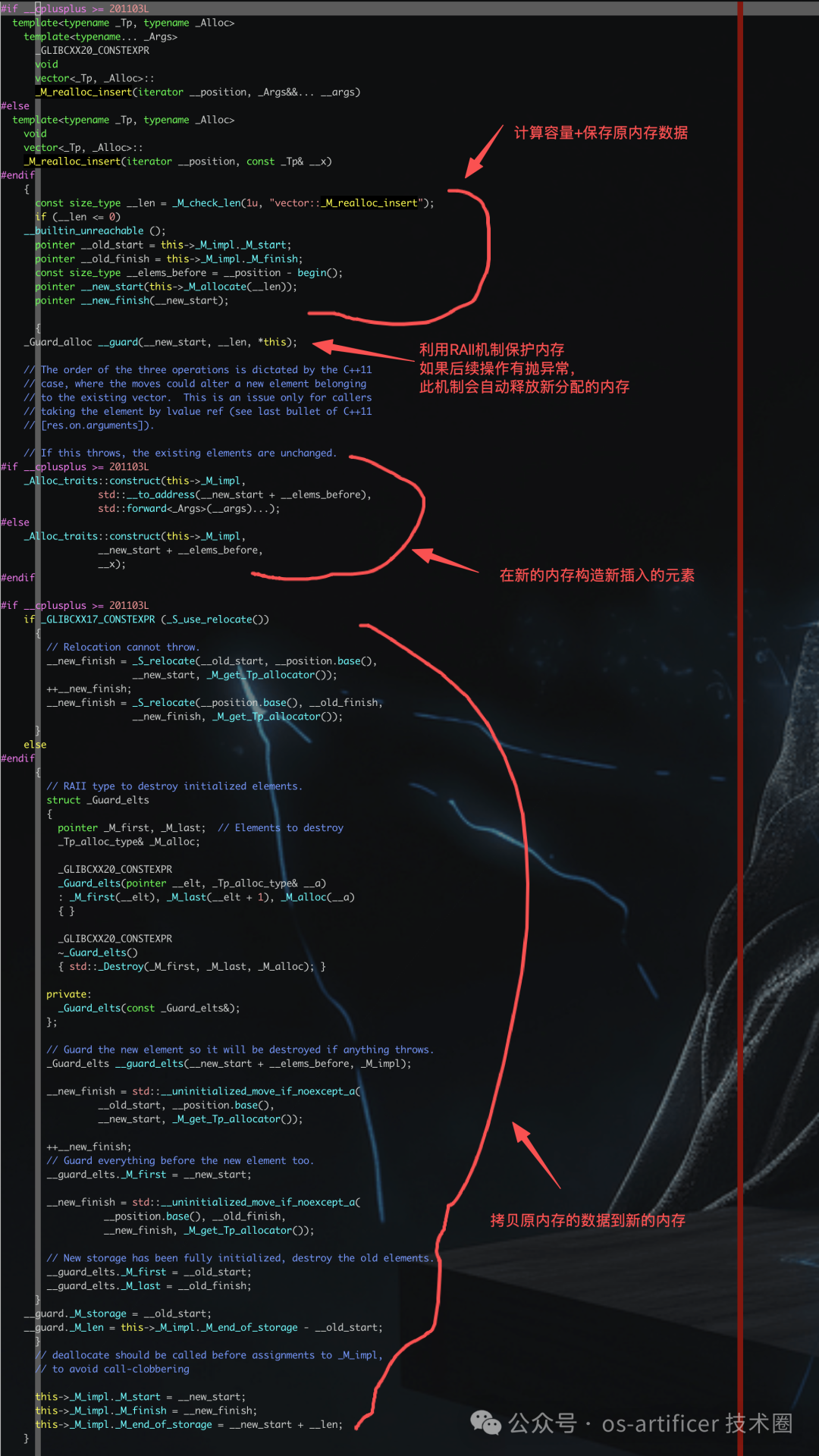
_M_realloc_insert 的实现充分体现了 STL 的强异常安全保证。它使用了一个 _Guard 类(一种RAII机制)来确保在构造元素发生异常时,所有已分配的资源(新内存、已构造的元素)都能被正确清理,避免内存泄漏。std::uninitialized_move_if_noexcept 的使用也是一个关键优化,它会在元素类型的移动构造函数被声明为 noexcept 时使用移动,否则回退到拷贝,以在性能和安全之间取得平衡。
总结
通过对 std::vector::insert 源码解析可以看出,其实现综合考虑了性能、异常安全和内存利用。主要优化点包括:
- 快速路径:在末尾插入且有剩余容量时,直接构造,效率最高。
- 缓冲区内移动:当有容量但需在中间插入时,通过巧妙的元素移动腾出空间,避免重新分配。
- 安全扩容:必须扩容时,采用先分配新内存、迁移数据、再释放旧内存的方式,并通过RAII和
move_if_noexcept确保操作的强异常安全性。
理解这些底层机制,有助于我们在日常开发中更好地使用 vector,预知其性能开销,并做出更合适的选择。希望这篇分析能为你深入理解C++标准库带来帮助。如果你想进一步探讨C++相关话题,欢迎在云栈社区交流。
 发表于 2026-1-22 04:14:43
|
查看: 304|
回复: 0
发表于 2026-1-22 04:14:43
|
查看: 304|
回复: 0

