当我们讨论“如何设计一个扛住千万级流量的系统”时,这不仅是面试中的高频问题,更是工程师在实际工作中需要面对的核心挑战。今天,我们将系统地探讨这个话题,通过一个完整的演进案例,揭示从零开始构建高性能、高可用、可扩展系统的关键路径。
01 三个关键点:明确设计的核心目标
在深入技术细节之前,我们必须首先明确设计的核心目标。任何复杂的架构都围绕着三个基本原则展开:
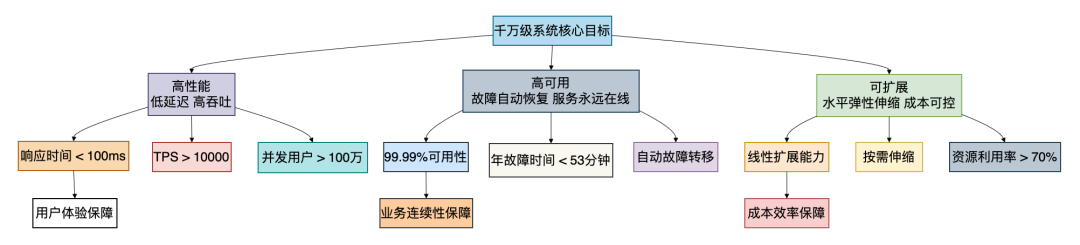
1. 高性能
这里的“高性能”绝非简单地追求速度。其核心在于,在保证业务逻辑绝对正确的前提下,利用有限的服务器资源处理尽可能多的请求。我们的量化目标通常是:核心接口的 P99 响应时间低于 100 毫秒,单机 QPS 不低于 5000。
2. 高可用
系统必须具备故障自愈的能力。我们追求的是“两个9”(99%)作为底线,“三个9”(99.9%)作为起点,并努力向“四个9”(99.99%)迈进。这意味着全年计划外的不可用时间需要控制在 53 分钟以内。
3. 可扩展
系统架构必须能随着业务的自然增长而平滑地扩展,并且扩展的成本是可控、可预测的。这包括了水平扩展(增加机器数量)和垂直扩展(优化单机性能)两个维度。
02 架构演进:从单体到千万级的四步走
让我们从一个最简单的电商系统开始,看它是如何一步步进化到能支撑千万级日请求的。
阶段一:单机单体架构(日请求<10万)
这个阶段,所有功能都打包在一个应用里。
// 最简单的Spring Boot单体应用
@SpringBootApplication
@RestController
public class MonolithicApp{

    @Autowired
    private ProductService productService;

    @Autowired
    private OrderService orderService;

    @GetMapping("/product/{id}")
    public Product getProduct(@PathVariable Long id){
        return productService.getById(id);
    }

    @PostMapping("/order")
    public Order createOrder(@RequestBody OrderRequest request){
        return orderService.createOrder(request);
    }

    public static void main(String[] args){
        SpringApplication.run(MonolithicApp.class, args);
    }
}
问题分析:
- 所有服务都运行在同一个 JVM 进程中,任何一个模块的严重 Bug 都可能导致整个系统崩溃。
- 数据库成为唯一的性能瓶颈点,且难以进行水平扩展。
- 每次发布新版本都需要停机,直接影响所有用户的体验。
阶段二:垂直拆分(日请求10万-100万)
当系统压力开始显现,第一步通常是按照业务领域进行垂直拆分。
// 商品服务 - 独立部署
@SpringBootApplication
@RestController
@RequestMapping("/product")
public class ProductServiceApp{

    @GetMapping("/{id}")
    public Product getProduct(@PathVariable Long id){
        // 直接查询数据库
        return productRepository.findById(id).orElse(null);
    }
}

// 订单服务 - 独立部署
@SpringBootApplication
@RestController
@RequestMapping("/order")
public class OrderServiceApp{

    @PostMapping("/")
    public Order createOrder(@RequestBody OrderRequest request){
        // 通过HTTP调用商品服务
        Product product = restTemplate.getForObject(
            "http://product-service/product/" + request.getProductId(),
            Product.class
        );
        // 创建订单逻辑
        return orderRepository.save(order);
    }
}
关键改进:
- 数据库按业务拆分:商品库、订单库等实现物理分离。
- 服务独立部署:实现了故障隔离,商品服务的问题不会影响订单服务。
- 针对性优化:可以根据不同服务的特性(如读多写少)进行独立的资源配置和技术选型。
阶段三:水平扩展与服务治理(日请求100万-500万)
当单个服务实例无法承载流量时,我们开始进行水平扩展,并引入服务治理能力。
# Kubernetes部署配置文件示例
apiVersion: apps/v1
kind: Deployment
metadata:
  name: product-service
spec:
  replicas: 3 # 3个实例
  selector:
    matchLabels:
      app: product-service
  template:
    metadata:
      labels:
        app: product-service
    spec:
      containers:
      - name: product-service
        image: product-service:latest
        resources:
          limits:
            memory: "512Mi"
            cpu: "500m"
        readinessProbe: # 就绪探针
          httpGet:
            path: /actuator/health
            port: 8080
          initialDelaySeconds: 30
          periodSeconds: 10
        livenessProbe: # 存活探针
          httpGet:
            path: /actuator/health
            port: 8080
          initialDelaySeconds: 60
          periodSeconds: 10
---
apiVersion: v1
kind: Service
metadata:
  name: product-service
spec:
  selector:
    app: product-service
  ports:
  - port: 80
    targetPort: 8080
  type: ClusterIP
关键改进:
- 服务多实例部署:通过负载均衡将流量分发到多个实例。
- 引入服务注册与发现:使用如 Nacos、Consul 等组件,动态管理服务实例。
- 健康检查与故障转移:Kubernetes 的探针机制可以自动剔除不健康的实例,并将流量转移到健康实例。
- 配置中心:实现配置的集中管理和动态更新。
阶段四:全链路优化(日请求500万以上)
当系统规模持续扩大,我们需要进行更精细、更深度的全链路优化。下图展示了一个成熟的千万级流量系统架构全景:

一个健壮的系统离不开完善的可观测性体系,其核心是监控告警:
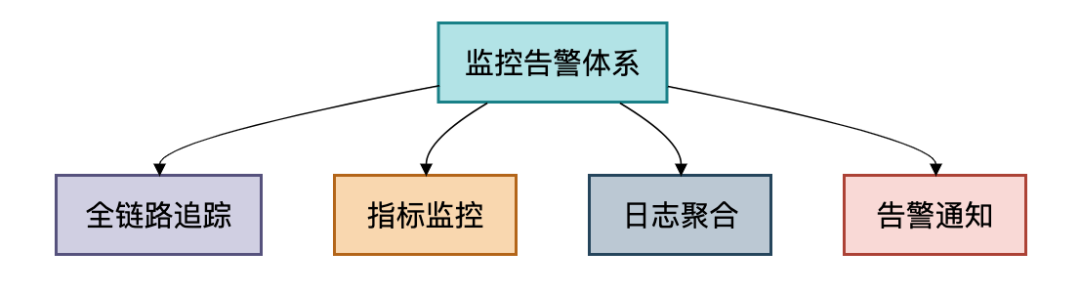
接下来,我们将深入剖析这张架构图中的每一个关键组件。
03 负载均衡:流量分发的高可用之道
负载均衡是应对海量流量的第一道防线,我们通常采用多层级的负载均衡策略来分担压力和保障可用性。
四层负载均衡(LVS/ELB)
四层负载均衡工作在 TCP/IP 协议栈的传输层,性能极高,适合做初步的流量分发。
# LVS DR模式配置示例
# 真实服务器配置回环接口
ifconfig lo:0 192.168.1.100 netmask 255.255.255.255 up
route add -host 192.168.1.100 dev lo:0

# 配置ARP抑制
echo "1" > /proc/sys/net/ipv4/conf/lo/arp_ignore
echo "2" > /proc/sys/net/ipv4/conf/lo/arp_announce
echo "1" > /proc/sys/net/ipv4/conf/all/arp_ignore
echo "2" > /proc/sys/net/ipv4/conf/all/arp_announce

# LVS Director配置
ipvsadm -A -t 192.168.1.100:80 -s wrr
ipvsadm -a -t 192.168.1.100:80 -r 192.168.1.10:8080 -g -w 1
ipvsadm -a -t 192.168.1.100:80 -r 192.168.1.11:8080 -g -w 2
七层负载均衡(Nginx/API网关)
七层负载均衡工作在应用层,能够识别 HTTP/HTTPS 协议,实现更精细的路由、限流和过滤。
# Nginx负载均衡配置
upstream backend_servers {
    # 加权轮询,配合健康检查
    server 192.168.1.10:8080 weight=3 max_fails=3 fail_timeout=30s;
    server 192.168.1.11:8080 weight=2 max_fails=3 fail_timeout=30s;
    server 192.168.1.12:8080 weight=1 max_fails=3 fail_timeout=30s;

    # 会话保持(需要时开启)
    # sticky cookie srv_id expires=1h domain=.example.com path=/;

    # 备份服务器
    server 192.168.1.13:8080 backup;
}

server {
    listen 80;
    server_name api.example.com;

    # 限流配置
    limit_req_zone $binary_remote_addr zone=api_limit:10m rate=100r/s;

    location /api/ {
        # 应用限流
        limit_req zone=api_limit burst=50 nodelay;

        # 连接超时设置
        proxy_connect_timeout 3s;
        proxy_read_timeout 10s;
        proxy_send_timeout 10s;

        # 负载均衡
        proxy_pass http://backend_servers;

        # 故障转移
        proxy_next_upstream error timeout invalid_header http_500 http_502 http_503;
        proxy_next_upstream_timeout 0;
        proxy_next_upstream_tries 3;

        # 添加代理头
        proxy_set_header Host $host;
        proxy_set_header X-Real-IP $remote_addr;
        proxy_set_header X-Forwarded-For $proxy_add_x_forwarded_for;
    }

    # 健康检查端点
    location /health {
        access_log off;
        return 200 "healthy\n";
    }
}
现代API网关(Spring Cloud Gateway)
现代微服务架构中,API 网关承担了更重要的角色,集路由、过滤、限流、熔断于一体。
@Configuration
public class GatewayConfig{

    @Bean
    public RouteLocator customRouteLocator(RouteLocatorBuilder builder){
        return builder.routes()
            .route("product_route", r -> r
                .path("/api/product/**")
                .filters(f -> f
                    .requestRateLimiter(config -> config
                        .setRateLimiter(redisRateLimiter())
                        .setKeyResolver(ipKeyResolver()))
                    .circuitBreaker(config -> config
                        .setName("productCircuitBreaker")
                        .setFallbackUri("forward:/fallback/product"))
                    .rewritePath("/api/(?<segment>.*)", "/${segment}")
                )
                .uri("lb://product-service"))
            .route("order_route", r -> r
                .path("/api/order/**")
                .filters(f -> f
                    .requestRateLimiter(config -> config
                        .setRateLimiter(redisRateLimiter())
                        .setKeyResolver(userKeyResolver()))
                    .retry(config -> config
                        .setRetries(3)
                        .setStatuses(HttpStatus.INTERNAL_SERVER_ERROR))
                )
                .uri("lb://order-service"))
            .build();
    }

    @Bean
    public RedisRateLimiter redisRateLimiter(){
        // 每秒10个请求,突发容量20
        return new RedisRateLimiter(10, 20, 1);
    }

    @Bean
    public KeyResolver ipKeyResolver(){
        return exchange -> Mono.just(
            exchange.getRequest().getRemoteAddress().getAddress().getHostAddress()
        );
    }
}
04 缓存策略:性能加速的智能分层
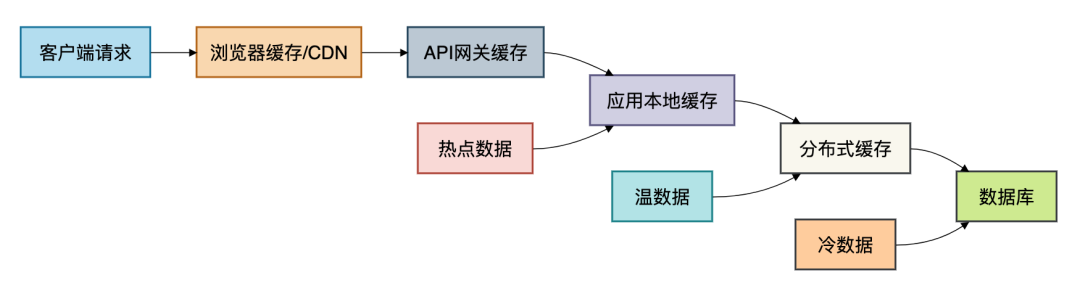
缓存是提升系统性能最有效的手段,没有之一。但对于千万级系统,简单的缓存已不再足够,我们需要设计智能的、多层次缓存策略。下图清晰地展示了数据在各级缓存中的流动:
1. 本地缓存(Caffeine)
本地缓存访问速度最快,但容量有限,且无法在多实例间共享。通常用于存储极热的数据。
@Component
public class LocalCacheManager{

    // 一级缓存:Guava Cache(适合较小数据量)
    private final Cache<String, Object> guavaCache = CacheBuilder.newBuilder()
            .maximumSize(10000)
            .expireAfterWrite(5, TimeUnit.MINUTES)
            .recordStats()
            .build();

    // 二级缓存:Caffeine(高性能,W-TinyLFU算法)
    private final Cache<String, Object> caffeineCache = Caffeine.newBuilder()
            .maximumSize(50000)
            .expireAfterWrite(10, TimeUnit.MINUTES)
            .refreshAfterWrite(1, TimeUnit.MINUTES)
            .recordStats()
            .build();

    // 热点数据特殊缓存(如秒杀商品)
    private final Cache<String, Object> hotDataCache = Caffeine.newBuilder()
            .maximumSize(1000)
            .expireAfterWrite(30, TimeUnit.SECONDS) // 热点数据过期快
            .recordStats()
            .build();

    public <T> T getWithCache(String key, Class<T> clazz,
                              Supplier<T> loader, CacheLevel level){
        switch (level) {
            case LOCAL_HOT:
                return getFromHotCache(key, clazz, loader);
            case LOCAL_NORMAL:
                return getFromLocalCache(key, clazz, loader);
            case DISTRIBUTED:
                return getFromDistributedCache(key, clazz, loader);
            default:
                return loader.get();
        }
    }

    private <T> T getFromLocalCache(String key, Class<T> clazz, Supplier<T> loader){
        try {
            return (T) caffeineCache.get(key, k -> {
                T value = loader.get();
                if (value == null) {
                    // 缓存空值,防止缓存穿透
                    return new NullValue();
                }
                return value;
            });
        } catch (Exception e) {
            // 本地缓存异常,降级直接加载
            return loader.get();
        }
    }
}

// 使用示例
@Service
public class ProductService{

    @Autowired
    private LocalCacheManager cacheManager;

    @Autowired
    private RedisTemplate<String, Product> redisTemplate;

    public Product getProductWithCache(Long productId){
        String cacheKey = "product:" + productId;

        return cacheManager.getWithCache(cacheKey, Product.class, () -> {
            // 先查Redis分布式缓存
            Product product = redisTemplate.opsForValue().get(cacheKey);
            if (product != null) {
                return product;
            }

            // Redis没有,查数据库
            product = productRepository.findById(productId).orElse(null);
            if (product != null) {
                // 异步回写到Redis,不阻塞当前请求
                CompletableFuture.runAsync(() ->
                    redisTemplate.opsForValue().set(cacheKey, product, 1, TimeUnit.HOURS)
                );
            }

            return product;
        }, CacheLevel.LOCAL_NORMAL);
    }
}
2. 分布式缓存(Redis集群)
Redis 作为高性能的分布式缓存,是应对高并发读请求的核心组件。必须采用集群模式来保障高可用和可扩展性。
@Configuration
public class RedisConfig{

    @Bean
    public RedisConnectionFactory redisConnectionFactory(){
        RedisClusterConfiguration clusterConfig = new RedisClusterConfiguration();

        // 集群节点配置
        clusterConfig.addClusterNode(new RedisNode("192.168.1.100", 6379));
        clusterConfig.addClusterNode(new RedisNode("192.168.1.101", 6379));
        clusterConfig.addClusterNode(new RedisNode("192.168.1.102", 6379));

        // 集群配置
        clusterConfig.setMaxRedirects(3); // 最大重定向次数

        return new JedisConnectionFactory(clusterConfig);
    }

    @Bean
    public RedisTemplate<String, Object> redisTemplate(){
        RedisTemplate<String, Object> template = new RedisTemplate<>();
        template.setConnectionFactory(redisConnectionFactory());

        // 使用String序列化器
        template.setKeySerializer(new StringRedisSerializer());
        template.setValueSerializer(new GenericJackson2JsonRedisSerializer());

        // 开启事务支持
        template.setEnableTransactionSupport(true);

        return template;
    }

    @Bean
    public RedisCacheManager cacheManager(RedisConnectionFactory connectionFactory){
        RedisCacheConfiguration config = RedisCacheConfiguration.defaultCacheConfig()
                .entryTtl(Duration.ofMinutes(30)) // 默认过期时间
                .disableCachingNullValues() // 不缓存null值
                .serializeKeysWith(RedisSerializationContext.SerializationPair
                        .fromSerializer(new StringRedisSerializer()))
                .serializeValuesWith(RedisSerializationContext.SerializationPair
                        .fromSerializer(new GenericJackson2JsonRedisSerializer()));

        // 不同缓存区域的不同配置
        Map<String, RedisCacheConfiguration> cacheConfigurations = new HashMap<>();
        cacheConfigurations.put("product", config.entryTtl(Duration.ofHours(1)));
        cacheConfigurations.put("user", config.entryTtl(Duration.ofDays(1)));

        return RedisCacheManager.builder(connectionFactory)
                .cacheDefaults(config)
                .withInitialCacheConfigurations(cacheConfigurations)
                .transactionAware()
                .build();
    }
}
3. 缓存策略与问题解决
仅仅使用缓存还不够,我们必须妥善处理缓存带来的三大经典问题:穿透、击穿和雪崩。
@Service
public class CacheStrategyService{

    /**
     * 防止缓存穿透:缓存空值
     */
    public Product getProductWithNullCache(Long productId){
        String cacheKey = "product:" + productId;
        String nullCacheKey = "product_null:" + productId;

        // 先检查空值缓存
        if (Boolean.TRUE.equals(redisTemplate.hasKey(nullCacheKey))) {
            return null; // 知道是空值,直接返回,不查数据库
        }

        Product product = redisTemplate.opsForValue().get(cacheKey);
        if (product != null) {
            return product;
        }

        // 加分布式锁,防止缓存击穿
        String lockKey = "lock:product:" + productId;
        boolean locked = false;
        try {
            locked = tryLock(lockKey, 3, TimeUnit.SECONDS);
            if (locked) {
                // 双重检查
                product = redisTemplate.opsForValue().get(cacheKey);
                if (product != null) {
                    return product;
                }

                // 查询数据库
                product = productRepository.findById(productId).orElse(null);

                if (product == null) {
                    // 缓存空值,过期时间短
                    redisTemplate.opsForValue().set(nullCacheKey, "NULL", 5, TimeUnit.MINUTES);
                } else {
                    // 缓存数据
                    redisTemplate.opsForValue().set(cacheKey, product, 1, TimeUnit.HOURS);
                }

                return product;
            } else {
                // 未获取到锁,短暂等待后重试或返回降级数据
                Thread.sleep(100);
                return getProductWithNullCache(productId);
            }
        } catch (InterruptedException e) {
            Thread.currentThread().interrupt();
            return null;
        } finally {
            if (locked) {
                releaseLock(lockKey);
            }
        }
    }

    /**
     * 防止缓存雪崩:随机过期时间
     */
    public void setWithRandomExpire(String key, Object value, long baseExpire, TimeUnit unit){
        long expireTime = unit.toMillis(baseExpire);

        // 增加随机偏移量(±20%)
        double randomFactor = 0.8 + Math.random() * 0.4; // 0.8 ~ 1.2
        long actualExpire = (long) (expireTime * randomFactor);

        redisTemplate.opsForValue().set(
            key, value, actualExpire, TimeUnit.MILLISECONDS
        );
    }

    /**
     * 热点数据发现与自动缓存
     */
    @Scheduled(fixedDelay = 60000) // 每分钟执行一次
    public void discoverHotData(){
        // 从Redis统计访问频率
        Set<String> hotKeys = findHotKeys();

        for (String key : hotKeys) {
            // 将热点数据加载到本地缓存
            Object value = redisTemplate.opsForValue().get(key);
            if (value != null) {
                localCache.put(key, value);
            }
        }
    }
}
05 数据库设计:从单机到分布式
数据库通常是整个系统的性能瓶颈和最难以扩展的部分。设计一个支持高并发的数据库架构,需要从多个层面入手。
读写分离
这是最基本的数据库扩展方案,将写操作集中到主库,读操作分散到多个从库。
@Configuration
public class DataSourceConfig{

    @Bean
    @Primary
    public DataSource dataSource(){
        // 主从数据源配置
        Map<Object, Object> targetDataSources = new HashMap<>();

        // 主库
        DataSource masterDataSource = createDataSource(
            "jdbc:mysql://master-db:3306/db?useSSL=false",
            "master_user",
            "master_password"
        );
        targetDataSources.put(DataSourceType.MASTER, masterDataSource);

        // 从库1
        DataSource slave1DataSource = createDataSource(
            "jdbc:mysql://slave1-db:3306/db?useSSL=false",
            "slave_user",
            "slave_password"
        );
        targetDataSources.put("slave1", slave1DataSource);

        // 从库2
        DataSource slave2DataSource = createDataSource(
            "jdbc:mysql://slave2-db:3306/db?useSSL=false",
            "slave_user",
            "slave_password"
        );
        targetDataSources.put("slave2", slave2DataSource);

        // 动态数据源
        DynamicDataSource dynamicDataSource = new DynamicDataSource();
        dynamicDataSource.setDefaultTargetDataSource(masterDataSource);
        dynamicDataSource.setTargetDataSources(targetDataSources);

        return dynamicDataSource;
    }

    @Bean
    public AbstractRoutingDataSource routingDataSource(){
        return new AbstractRoutingDataSource() {
            @Override
            protected Object determineCurrentLookupKey(){
                return DynamicDataSourceContextHolder.getDataSourceType();
            }
        };
    }

    @Aspect
    @Component
    public class DataSourceAspect{

        @Before("@annotation(com.example.annotation.Master)")
        public void setMasterDataSource(){
            DynamicDataSourceContextHolder.setDataSourceType(DataSourceType.MASTER);
        }

        @Before("@annotation(com.example.annotation.Slave)")
        public void setSlaveDataSource(){
            // 随机选择从库
            String[] slaves = {"slave1", "slave2"};
            String selectedSlave = slaves[ThreadLocalRandom.current().nextInt(slaves.length)];
            DynamicDataSourceContextHolder.setDataSourceType(selectedSlave);
        }

        @After("@annotation(com.example.annotation.Master) || " +
               "@annotation(com.example.annotation.Slave)")
        public void clearDataSource(){
            DynamicDataSourceContextHolder.clearDataSourceType();
        }
    }
}

// 使用示例
@Service
public class OrderService{

    @Master // 使用主库
    public void createOrder(Order order){
        orderRepository.save(order); // 写操作
    }

    @Slave // 使用从库
    public Order getOrder(Long orderId){
        return orderRepository.findById(orderId).orElse(null); // 读操作
    }
}
分库分表
当单表数据量或访问量达到瓶颈时,分库分表是不可避免的选择。这里以 ShardingSphere 为例。
// 分片策略:用户ID取模分片
@Component
public class UserShardingStrategy implements PreciseShardingAlgorithm<Long> {

    @Override
    public String doSharding(Collection<String> availableTargetNames,
                             PreciseShardingValue<Long> shardingValue){
        long userId = shardingValue.getValue();

        // 分片数
        int shardCount = availableTargetNames.size();

        // 简单取模分片
        long shardIndex = userId % shardCount;

        for (String tableName : availableTargetNames) {
            if (tableName.endsWith("_" + shardIndex)) {
                return tableName;
            }
        }

        throw new UnsupportedOperationException("无法找到对应的分片表");
    }
}

// 分库分表配置
@Configuration
public class ShardingConfig{

    @Bean
    public DataSource shardingDataSource() throws SQLException {
        // 数据源映射
        Map<String, DataSource> dataSourceMap = new HashMap<>();
        dataSourceMap.put("ds0", createDataSource("jdbc:mysql://db0:3306/db"));
        dataSourceMap.put("ds1", createDataSource("jdbc:mysql://db1:3306/db"));
        dataSourceMap.put("ds2", createDataSource("jdbc:mysql://db2:3306/db"));

        // 用户表分片规则
        ShardingRuleConfiguration shardingRuleConfig = new ShardingRuleConfiguration();

        // 用户表分表规则
        TableRuleConfiguration userTableRuleConfig = new TableRuleConfiguration("user", "ds${0..2}.user_${0..7}");
        userTableRuleConfig.setDatabaseShardingStrategyConfig(
            new InlineShardingStrategyConfiguration("id", "ds${id % 3}")
        );
        userTableRuleConfig.setTableShardingStrategyConfig(
            new StandardShardingStrategyConfiguration("id", new UserShardingStrategy())
        );

        // 订单表分表规则
        TableRuleConfiguration orderTableRuleConfig = new TableRuleConfiguration("order", "ds${0..2}.order_${0..15}");
        orderTableRuleConfig.setDatabaseShardingStrategyConfig(
            new InlineShardingStrategyConfiguration("user_id", "ds${user_id % 3}")
        );
        orderTableRuleConfig.setTableShardingStrategyConfig(
            new InlineShardingStrategyConfiguration("order_id", "order_${order_id % 16}")
        );

        shardingRuleConfig.getTableRuleConfigs().add(userTableRuleConfig);
        shardingRuleConfig.getTableRuleConfigs().add(orderTableRuleConfig);

        // 创建ShardingSphere数据源
        return ShardingSphereDataSourceFactory.createDataSource(
            dataSourceMap, Collections.singleton(shardingRuleConfig), new Properties()
        );
    }
}
数据库优化实战
除了架构上的扩展,SQL 和索引层面的优化是提升数据库性能的基石。
-- 1. 索引优化示例
-- 错误的索引设计
CREATE INDEX idx_user_email ON user(email); -- 过长的索引
CREATE INDEX idx_user_status ON user(status); -- 低区分度的索引

-- 正确的索引设计
-- 联合索引,注意字段顺序
CREATE INDEX idx_user_created_status ON user(created_at, status);
-- 前缀索引,适合长字段
CREATE INDEX idx_user_email_prefix ON user(email(20));

-- 2. 慢查询优化示例
-- 优化前:全表扫描
EXPLAIN SELECT * FROM order WHERE YEAR(created_at) = 2024;

-- 优化后:使用索引
EXPLAIN SELECT * FROM order
WHERE created_at >= '2024-01-01'
AND created_at < '2025-01-01';

-- 3. 分页优化
-- 传统分页(数据量大时慢)
SELECT * FROM user ORDER BY id LIMIT 1000000, 20;

-- 优化分页(使用覆盖索引)
SELECT * FROM user
WHERE id > (SELECT id FROM user ORDER BY id LIMIT 1000000, 1)
ORDER BY id LIMIT 20;

-- 4. 批量操作优化
-- 批量插入
INSERT INTO user (name, email) VALUES
('user1', 'user1@example.com'),
('user2', 'user2@example.com'),
-- ... 1000条
('user1000', 'user1000@example.com');

-- 批量更新(避免在循环中单条更新)
UPDATE user SET status = 'active'
WHERE id IN (1, 2, 3, ..., 1000);
06 异步处理与消息队列
对于千万级系统,同步处理所有请求是不现实的。异步化是解耦服务、提高吞吐量和最终一致性的关键。
消息队列设计
Kafka 作为高吞吐、分布式的消息系统,是大流量场景下的首选。
@Configuration
public class KafkaConfig{

    @Bean
    public ProducerFactory<String, String> producerFactory(){
        Map<String, Object> configProps = new HashMap<>();
        configProps.put(
            ProducerConfig.BOOTSTRAP_SERVERS_CONFIG,
            "kafka1:9092,kafka2:9092,kafka3:9092"
        );
        configProps.put(
            ProducerConfig.KEY_SERIALIZER_CLASS_CONFIG,
            StringSerializer.class
        );
        configProps.put(
            ProducerConfig.VALUE_SERIALIZER_CLASS_CONFIG,
            StringSerializer.class
        );
        // 高吞吐量配置
        configProps.put(ProducerConfig.LINGER_MS_CONFIG, 20); // 批量发送延迟
        configProps.put(ProducerConfig.BATCH_SIZE_CONFIG, 32 * 1024); // 批量大小
        configProps.put(ProducerConfig.COMPRESSION_TYPE_CONFIG, "lz4"); // 压缩

        // 高可靠性配置
        configProps.put(ProducerConfig.ACKS_CONFIG, "all"); // 所有副本确认
        configProps.put(ProducerConfig.RETRIES_CONFIG, 3); // 重试次数
        configProps.put(ProducerConfig.ENABLE_IDEMPOTENCE_CONFIG, true); // 幂等性

        return new DefaultKafkaProducerFactory<>(configProps);
    }

    @Bean
    public KafkaTemplate<String, String> kafkaTemplate(){
        return new KafkaTemplate<>(producerFactory());
    }
}

@Service
public class OrderMessageService{

    @Autowired
    private KafkaTemplate<String, String> kafkaTemplate;

    // 顺序消息发送
    public void sendOrderEvent(OrderEvent event){
        // 使用订单ID作为key,保证同一订单的消息顺序
        String key = String.valueOf(event.getOrderId());
        String topic = "order-events";

        kafkaTemplate.send(topic, key, JsonUtils.toJson(event))
            .addCallback(
                result -> log.info("消息发送成功: {}", event),
                ex -> {
                    log.error("消息发送失败: {}", event, ex);
                    // 失败处理:记录到数据库,定时重试
                    saveFailedMessage(event, ex.getMessage());
                }
            );
    }

    // 批量消息处理
    @KafkaListener(topics = "order-events",
                   containerFactory = "batchFactory")
    public void processOrderEvents(List<ConsumerRecord<String, String>> records){
        List<OrderEvent> events = new ArrayList<>();

        for (ConsumerRecord<String, String> record : records) {
            try {
                OrderEvent event = JsonUtils.fromJson(record.value(), OrderEvent.class);
                events.add(event);
            } catch (Exception e) {
                log.error("消息解析失败: {}", record.value(), e);
            }
        }

        if (!events.isEmpty()) {
            // 批量处理
            batchProcessOrders(events);
        }
    }

    @Bean
    public ConcurrentKafkaListenerContainerFactory<String, String> batchFactory(){
        ConcurrentKafkaListenerContainerFactory<String, String> factory =
            new ConcurrentKafkaListenerContainerFactory<>();
        factory.setConsumerFactory(consumerFactory());
        factory.setBatchListener(true); // 开启批量监听
        factory.getContainerProperties().setPollTimeout(3000);
        return factory;
    }
}
异步处理模式
除了消息队列,在应用内部我们也可以利用 CompletableFuture 和事件驱动模型来实现异步。
// 1. CompletableFuture异步处理
@Service
public class AsyncOrderService{

    @Autowired
    private ThreadPoolTaskExecutor taskExecutor;

    public CompletableFuture<OrderResult> createOrderAsync(OrderRequest request){
        return CompletableFuture.supplyAsync(() -> {
            // 第一步:校验
            validateOrder(request);
            return request;
        }, taskExecutor).thenComposeAsync(validatedRequest -> {
            // 第二步:扣减库存
            return reduceInventoryAsync(validatedRequest);
        }, taskExecutor).thenComposeAsync(inventoryResult -> {
            // 第三步:生成订单
            return generateOrderAsync(inventoryResult);
        }, taskExecutor).thenApplyAsync(order -> {
            // 第四步:发送通知
            sendNotification(order);
            return new OrderResult(order, "SUCCESS");
        }, taskExecutor).exceptionally(ex -> {
            // 异常处理
            log.error("订单创建失败", ex);
            return new OrderResult(null, "FAILED: " + ex.getMessage());
        });
    }

    // 2. 事件驱动架构
    @Component
    public class OrderEventPublisher{

        @Autowired
        private ApplicationEventPublisher eventPublisher;

        public void createOrder(Order order){
            // 保存订单
            orderRepository.save(order);
            // 发布领域事件
            eventPublisher.publishEvent(new OrderCreatedEvent(this, order));
        }
    }

    @Component
    public class OrderEventListener{

        @EventListener
        @Async
        public void handleOrderCreated(OrderCreatedEvent event){
            Order order = event.getOrder();
            // 异步发送邮件
            emailService.sendOrderConfirmation(order);
            // 异步更新统计数据
            statisticsService.updateOrderStats(order);
            // 异步通知库存系统
            inventoryService.notifyOrderCreated(order);
        }
    }
}
07 监控与治理:系统的眼睛和大脑
一个没有完善监控的千万级系统,无异于在黑暗中高速驾驶。监控体系是我们发现、诊断、预警问题的唯一途径。
全链路监控
// 1. 链路追踪(基于SkyWalking)
@Configuration
public class TracingConfig{

    @Bean
    public Tracer skywalkingTracer(){
        // SkyWalking自动注入,只需添加依赖
        return new SkywalkingTracer();
    }
}

// 在业务代码中自动追踪
@Service
public class ProductService{

    @Trace(operationName = "ProductService.getProduct") // SkyWalking注解
    @Tag(key = "productId", value = "arg[0]") // 添加标签
    public Product getProduct(Long productId){
        // 业务逻辑
        return productRepository.findById(productId).orElse(null);
    }
}

// 2. 指标监控(Micrometer + Prometheus)
@Configuration
public class MetricsConfig{

    @Bean
    public MeterRegistry meterRegistry(){
        return new PrometheusMeterRegistry(PrometheusConfig.DEFAULT);
    }

    @Bean
    public TimedAspect timedAspect(MeterRegistry registry){
        return new TimedAspect(registry);
    }
}

@Service
public class OrderService{

    private final Counter orderCounter;
    private final Timer orderTimer;

    public OrderService(MeterRegistry registry){
        orderCounter = Counter.builder("orders.created")
            .description("创建的订单数量")
            .tag("type", "normal")
            .register(registry);

        orderTimer = Timer.builder("orders.process.time")
            .description("订单处理时间")
            .publishPercentiles(0.5, 0.95, 0.99) // 50%, 95%, 99%分位数
            .register(registry);
    }

    @Timed(value = "orders.create", extraTags = {"priority", "high"})
    public Order createOrder(OrderRequest request){
        return orderTimer.record(() -> {
            Order order = processOrder(request);
            orderCounter.increment();
            return order;
        });
    }
}

// 3. 健康检查
@Component
public class CustomHealthIndicator implements HealthIndicator{

    @Autowired
    private DataSource dataSource;

    @Autowired
    private RedisConnectionFactory redisConnectionFactory;

    @Override
    public Health health(){
        // 检查数据库连接
        boolean dbHealthy = checkDatabase();
        // 检查Redis连接
        boolean redisHealthy = checkRedis();
        // 检查磁盘空间
        boolean diskHealthy = checkDiskSpace();

        if (dbHealthy && redisHealthy && diskHealthy) {
            return Health.up()
                .withDetail("database", "connected")
                .withDetail("redis", "connected")
                .withDetail("disk", "sufficient")
                .build();
        } else {
            Map<String, Object> details = new HashMap<>();
            details.put("database", dbHealthy ? "connected" : "disconnected");
            details.put("redis", redisHealthy ? "connected" : "disconnected");
            details.put("disk", diskHealthy ? "sufficient" : "insufficient");
            return Health.down().withDetails(details).build();
        }
    }

    private boolean checkDatabase(){
        try {
            return dataSource.getConnection().isValid(5);
        } catch (SQLException e) {
            return false;
        }
    }
}
智能告警
有了监控数据,还需要配置合理的告警规则,让系统在出现异常时能主动呼唤我们。
# Prometheus告警规则
groups:
- name: application_alerts
  rules:
  # 错误率告警
  - alert: HighErrorRate
    expr: rate(http_requests_total{status=~"5.."}[5m]) / rate(http_requests_total[5m]) > 0.01
    for: 2m
    labels:
      severity: critical
    annotations:
      summary: "高错误率告警"
      description: "错误率超过1% (当前值: {{ $value }})"

  # 延迟告警
  - alert: HighLatency
    expr: histogram_quantile(0.95, rate(http_request_duration_seconds_bucket[5m])) > 1
    for: 5m
    labels:
      severity: warning
    annotations:
      summary: "高延迟告警"
      description: "95分位延迟超过1秒 (当前值: {{ $value }}s)"

  # 服务宕机告警
  - alert: ServiceDown
    expr: up == 0
    for: 1m
    labels:
      severity: critical
    annotations:
      summary: "服务宕机告警"
      description: "{{ $labels.job }} 服务已宕机"
08 实战案例:秒杀系统设计
让我们用一个具体的“秒杀”场景来综合运用上述所有技术。秒杀是对系统高并发、高性能、高一致性的极限挑战。
@Service
public class SeckillService{

    // 1. 缓存预热
    @PostConstruct
    public void warmUpCache(){
        List<SeckillProduct> hotProducts = findHotProducts();

        hotProducts.parallelStream().forEach(product -> {
            String stockKey = "seckill:stock:" + product.getId();
            redisTemplate.opsForValue().set(stockKey, product.getStock());

            // 设置随机过期时间,防止雪崩
            setWithRandomExpire(stockKey, product.getStock(), 10, TimeUnit.MINUTES);
        });
    }

    // 2. 秒杀入口(防刷+限流)
    @RateLimiter(key = "'seckill:' + #userId",
                 limit = 1, period = 10, unit = TimeUnit.SECONDS)
    public SeckillResult seckill(Long userId, Long productId){
        // 2.1 资格校验(Redis实现)
        String userKey = "seckill:user:" + productId + ":" + userId;
        if (Boolean.TRUE.equals(redisTemplate.hasKey(userKey))) {
            return SeckillResult.alreadyParticipated();
        }

        // 2.2 库存预扣减(Lua脚本保证原子性)
        String stockKey = "seckill:stock:" + productId;
        Long remaining = redisTemplate.execute(
            stockDecrScript,
            Collections.singletonList(stockKey),
            "1"
        );

        if (remaining < 0) {
            // 库存不足,回滚
            redisTemplate.opsForValue().increment(stockKey, 1);
            return SeckillResult.outOfStock();
        }

        // 2.3 记录用户购买资格
        redisTemplate.opsForValue().set(userKey, "1", 1, TimeUnit.HOURS);

        // 2.4 发送消息到队列,异步创建订单
        String orderKey = "seckill:order:" + UUID.randomUUID();
        SeckillOrderMessage message = new SeckillOrderMessage(userId, productId, orderKey);

        kafkaTemplate.send("seckill-orders",
            String.valueOf(productId),
            JsonUtils.toJson(message)
        );

        return SeckillResult.success(orderKey);
    }

    // 3. 异步订单处理
    @KafkaListener(topics = "seckill-orders",
                   groupId = "seckill-order-processor")
    public void processSeckillOrder(String message){
        SeckillOrderMessage orderMessage = JsonUtils.fromJson(message, SeckillOrderMessage.class);

        try {
            // 3.1 创建订单(数据库操作)
            Order order = createOrderInDB(orderMessage);

            // 3.2 更新缓存状态
            String resultKey = "seckill:result:" + orderMessage.getOrderKey();
            redisTemplate.opsForValue().set(resultKey, order.getId(), 10, TimeUnit.MINUTES);

            // 3.3 发送成功通知
            notifyUser(orderMessage.getUserId(), order);

        } catch (Exception e) {
            log.error("处理秒杀订单失败", e);

            // 失败处理:恢复库存
            String stockKey = "seckill:stock:" + orderMessage.getProductId();
            redisTemplate.opsForValue().increment(stockKey, 1);

            // 移除用户资格记录
            String userKey = "seckill:user:" + orderMessage.getProductId() + ":" + orderMessage.getUserId();
            redisTemplate.delete(userKey);
        }
    }

    // 4. 库存扣减Lua脚本
    private final DefaultRedisScript<Long> stockDecrScript = new DefaultRedisScript<>(
        "local key = KEYS[1]\n" +
        "local decrement = tonumber(ARGV[1])\n" +
        "local current = redis.call('get', key)\n" +
        "if not current then\n" +
        "    return -1\n" +
        "end\n" +
        "local currentNum = tonumber(current)\n" +
        "if currentNum < decrement then\n" +
        "    return -1\n" +
        "end\n" +
        "return redis.call('decrby', key, decrement)",
        Long.class
    );
}
总结
设计一个能扛住千万级流量的系统,其本质不是简单堆砌各种时髦的技术组件,而是构建一个有机的、能够自我调节和演进的生态系统。
回顾全文,我们从明确目标开始,经历了架构的四个演进阶段,深入剖析了负载均衡、智能缓存、数据库扩展、异步处理、监控告警等核心领域,并最终通过一个秒杀案例进行了综合实践。希望这个系统性的梳理能为你带来启发。
最后,让我提炼几个最关键的心得:
- 架构是演进而来的:切忌一开始就追求所谓“完美”的复杂架构。从符合当前业务需求的、小而美的单体开始,随着压力增长,逐步进行拆分、优化和扩展。
- 缓存是性能的银弹,但要用得聪明:多级缓存、智能淘汰策略、以及针对穿透、击穿、雪崩的防御方案,每一个细节都至关重要。
- 数据库通常是瓶颈所在:读写分离、分库分表是解决规模问题的关键,而扎实的索引优化与 SQL 调优基本功,其价值远超任何炫酷的新技术。
- 异步是系统扩展性的关键:能异步处理的绝不占用同步线程,能批量操作的绝不单条处理。消息队列、事件驱动等模式,是实现系统松耦合、高内聚的利器。
- 监控是系统的眼睛,没有监控就是在裸奔:全链路追踪、多维指标监控、集中式日志和智能告警,是保障系统稳定运行的基石,缺一不可。
- 容错设计比性能优化更重要:必须承认系统一定会出问题。因此,熔断、降级、限流、重试等容错机制,是比追求极致性能更重要的“保险绳”。
真正的架构能力,不在于掌握了多少框架的配置,而在于能否在复杂的业务需求、技术实现的复杂度、团队的执行能力以及有限的资源约束之间,找到那个最务实、最具弹性的平衡点。如果你希望深入探讨更多关于高并发系统设计的实战细节,欢迎在云栈社区与同行们继续交流。
 发表于 2026-2-11 08:48:08
|
查看: 401|
回复: 0
发表于 2026-2-11 08:48:08
|
查看: 401|
回复: 0

