在现代工业自动化和物联网应用中,串口通信依然是一种至关重要的数据传输方式。然而,你是否遇到过这样的挑战:使用传统的串口接收程序处理高频数据时,常常出现丢包、界面卡顿,甚至程序崩溃的情况?本文将分享一套完整的C#高性能串口数据接收解决方案,从底层优化到UI设计,帮助你构建一个真正适用于工业环境的串口通信应用。
我们将深入剖析高性能串口通信的核心技术,提供完整、可运行的代码实现,并分享在实际项目中积累的“踩坑”经验。无论你是工业软件开发工程师,还是物联网项目的实施者,这套方案都能显著提升你现有串口应用的性能和稳定性。
传统串口通信的性能瓶颈
痛点分析
大多数开发者在处理串口通信时都会遇到以下几类问题:
1. 数据处理效率低下
- 传统方式每接收一个字节就触发一次事件处理
- UI线程因频繁更新而导致界面卡顿
- 内存碎片化严重,垃圾回收频繁
2. 数据包边界识别困难
- 在连续数据流中如何准确分割数据包
- 网络延迟可能导致的数据包分片问题
- 静默时间判断不准确,容易造成粘包或拆包错误
3. 程序关闭时的死锁问题
SerialPort.Close()在UI线程中可能造成阻塞- 后台数据处理线程无法正常退出
- 资源释放不完整导致端口被异常占用
高性能解决方案设计
核心设计思想
我们的解决方案采用 生产者-消费者模式,将数据接收与数据处理这两个关键环节完全分离。
// 核心架构:异步队列 + 批量处理
private readonly ConcurrentQueue<byte> dataQueue = new ConcurrentQueue<byte>();
private readonly CancellationTokenSource cancellation = new CancellationTokenSource();
private Task processingTask;
关键技术点:
- 无锁队列:使用
ConcurrentQueue 实现线程安全且高效的数据传递。
- 批量处理:大幅降低事件触发频率,从而提升整体处理效率。
- 智能分包:基于静默时间和缓冲区大小的双重策略,实现数据包的精确切分。
- 异常隔离:确保单个数据包的处理异常不会影响整体通信流程。
完整代码实现
高性能接收器核心类
using System;
using System.Collections.Concurrent;
using System.Collections.Generic;
using System.IO.Ports;
using System.Linq;
using System.Threading;
using System.Threading.Tasks;

namespace AppHighPerformanceSerialPort
{
    public class HighPerformanceReceiver : IDisposable
    {
        private SerialPort serialPort;
        private readonly ConcurrentQueue<byte> dataQueue = new ConcurrentQueue<byte>();
        private readonly CancellationTokenSource cancellation = new CancellationTokenSource();
        private Task processingTask;
        private bool disposed = false;

        public event Action<byte[]> PacketReceived;
        public int ProcessingIntervalMs { get; set; } = 5;
        public int SilenceThresholdMs { get; set; } = 50;
        public int MaxBufferSize { get; set; } = 4096;

        public HighPerformanceReceiver(string portName, int baudRate)
        {
            InitializeSerialPort(portName, baudRate);
            processingTask = Task.Run(ProcessDataAsync, cancellation.Token);
        }

        private void InitializeSerialPort(string portName, int baudRate)
        {
            serialPort = new SerialPort(portName, baudRate, Parity.None, 8, StopBits.One)
            {
                ReadTimeout = 1000,
                WriteTimeout = 1000
            };
            serialPort.DataReceived += OnDataReceived;
            serialPort.Open();
        }

        private void OnDataReceived(object sender, SerialDataReceivedEventArgs e)
        {
            if (disposed || cancellation.Token.IsCancellationRequested)
                return;

            try
            {
                while (serialPort?.IsOpen == true && serialPort.BytesToRead > 0)
                {
                    int data = serialPort.ReadByte();
                    if (data != -1)
                    {
                        dataQueue.Enqueue((byte)data);
                    }
                }
            }
            catch (Exception ex)
            {
                if (!disposed)
                {
                    Console.WriteLine($"数据接收异常: {ex.Message}");
                }
            }
        }

        private async Task ProcessDataAsync()
        {
            var buffer = new List<byte>();
            var lastDataTime = DateTime.MinValue;

            try
            {
                while (!cancellation.Token.IsCancellationRequested)
                {
                    bool hasData = false;
                    DateTime currentTime = DateTime.Now;

                    // 批量处理队列中的数据
                    while (dataQueue.TryDequeue(out byte data))
                    {
                        buffer.Add(data);
                        lastDataTime = currentTime;
                        hasData = true;

                        if (buffer.Count >= MaxBufferSize)
                        {
                            await EmitPacket(buffer.ToArray());
                            buffer.Clear();
                            break;
                        }
                    }

                    // 检查静默超时
                    if (!hasData && buffer.Count > 0 && lastDataTime != DateTime.MinValue)
                    {
                        double silenceDuration = (currentTime - lastDataTime).TotalMilliseconds;
                        if (silenceDuration >= SilenceThresholdMs)
                        {
                            await EmitPacket(buffer.ToArray());
                            buffer.Clear();
                            lastDataTime = DateTime.MinValue;
                        }
                    }

                    await Task.Delay(ProcessingIntervalMs, cancellation.Token);
                }
            }
            catch (OperationCanceledException)
            {
            }
            catch (Exception ex)
            {
                if (!disposed)
                {
                    Console.WriteLine($"数据处理异常: {ex.Message}");
                }
            }
            finally
            {
                // 处理剩余数据
                if (buffer.Count > 0)
                {
                    try
                    {
                        await EmitPacket(buffer.ToArray());
                    }
                    catch
                    {
                    }
                }
            }
        }

        private async Task EmitPacket(byte[] packet)
        {
            if (packet.Length > 0 && !disposed)
            {
                try
                {
                    await Task.Run(() => PacketReceived?.Invoke(packet));
                }
                catch
                {
                }
            }
        }

        public void Dispose()
        {
            if (disposed)
                return;

            disposed = true;

            try
            {
                // 取消处理任务
                cancellation.Cancel();

                // 先关闭串口,停止数据接收
                if (serialPort?.IsOpen == true)
                {
                    serialPort.Close();
                }

                // 等待处理任务完成,但不阻塞太久
                if (processingTask != null && !processingTask.IsCompleted)
                {
                    if (!processingTask.Wait(500)) // 减少等待时间到500ms
                    {
                        // 如果任务没有在500ms内完成,强制继续
                        Console.WriteLine("处理任务未能及时完成,强制退出");
                    }
                }
            }
            catch (Exception ex)
            {
                Console.WriteLine($"Dispose异常: {ex.Message}");
            }
            finally
            {
                try
                {
                    serialPort?.Dispose();
                    cancellation?.Dispose();
                }
                catch
                {
                    // 忽略最终清理时的异常
                }
            }
        }
    }
}
工业级UI界面实现
接下来是实现一个用户友好的Windows窗体界面,它集成了我们上面的高性能接收器,并提供丰富的控制和显示功能。开发这种交互逻辑复杂的界面时,理解 多线程 和 UI 更新的协作是关键。
using System;
using System.Drawing;
using System.IO;
using System.IO.Ports;
using System.Linq;
using System.Text;
using System.Threading.Tasks;
using System.Windows.Forms;
using Timer = System.Windows.Forms.Timer;

namespace AppHighPerformanceSerialPort
{
    public partial class FrmMain : Form
    {
        private HighPerformanceReceiver receiver;
        private DateTime startTime;
        private long totalBytesReceived;
        private long totalPacketsReceived;
        private DateTime lastPacketTime;
        private Timer timeTimer;
        private Timer statsTimer;
        private bool isClosing = false;

        public FrmMain()
        {
            InitializeComponent();
            InitializeApplication();
        }

        private void InitializeApplication()
        {
            RefreshPortList();
            cmbBaudRate.SelectedIndex = 4; // 115200

            ResetStatistics();
            timeTimer = new Timer();
            timeTimer.Interval = 1000;
            timeTimer.Tick += TimeTimer_Tick;
            timeTimer.Start();

            statsTimer = new Timer();
            statsTimer.Interval = 1000;
            statsTimer.Tick += StatsTimer_Tick;

            // 绑定设置变更事件
            nudProcessingInterval.ValueChanged += SettingsChanged;
            nudSilenceThreshold.ValueChanged += SettingsChanged;
            nudMaxBuffer.ValueChanged += SettingsChanged;
        }

        private void TimeTimer_Tick(object sender, EventArgs e)
        {
            if (!isClosing)
            {
                tsslTime.Text = DateTime.Now.ToString("yyyy-MM-dd HH:mm:ss");
            }
        }

        private void StatsTimer_Tick(object sender, EventArgs e)
        {
            if (!isClosing && startTime != DateTime.MinValue)
            {
                var elapsed = DateTime.Now - startTime;
                if (elapsed.TotalSeconds > 0)
                {
                    var bytesPerSecond = totalBytesReceived / elapsed.TotalSeconds;
                    lblDataRateValue.Text = $"{bytesPerSecond:F1} B/s";
                }
            }
        }

        private void RefreshPortList()
        {
            cmbPort.Items.Clear();
            var ports = SerialPort.GetPortNames().OrderBy(p => p).ToArray();
            cmbPort.Items.AddRange(ports);

            if (ports.Length > 0)
            {
                cmbPort.SelectedIndex = 0;
            }

            if (!isClosing)
            {
                tsslStatus.Text = $"发现 {ports.Length} 个串口";
            }
        }

        private void btnRefresh_Click(object sender, EventArgs e)
        {
            RefreshPortList();
        }

        private async void btnConnect_Click(object sender, EventArgs e)
        {
            if (cmbPort.SelectedItem == null || cmbBaudRate.SelectedItem == null)
            {
                MessageBox.Show("请选择串口和波特率!", "错误", MessageBoxButtons.OK, MessageBoxIcon.Warning);
                return;
            }

            try
            {
                string portName = cmbPort.SelectedItem.ToString();
                int baudRate = int.Parse(cmbBaudRate.SelectedItem.ToString());

                // 创建接收器
                receiver = new HighPerformanceReceiver(portName, baudRate);
                receiver.ProcessingIntervalMs = (int)nudProcessingInterval.Value;
                receiver.SilenceThresholdMs = (int)nudSilenceThreshold.Value;
                receiver.MaxBufferSize = (int)nudMaxBuffer.Value;
                receiver.PacketReceived += OnPacketReceived;

                // 更新UI状态
                btnConnect.Enabled = false;
                btnDisconnect.Enabled = true;
                cmbPort.Enabled = false;
                cmbBaudRate.Enabled = false;

                tsslConnection.Text = $"已连接 {portName}@{baudRate}";
                tsslConnection.ForeColor = Color.Green;
                tsslStatus.Text = "串口连接成功";

                // 重置统计
                ResetStatistics();
                startTime = DateTime.Now;
                statsTimer.Start();
            }
            catch (Exception ex)
            {
                MessageBox.Show($"连接失败:{ex.Message}", "错误", MessageBoxButtons.OK, MessageBoxIcon.Error);
                tsslStatus.Text = "连接失败";
            }
        }

        private void btnDisconnect_Click(object sender, EventArgs e)
        {
            DisconnectSerial();
        }

        private void DisconnectSerial()
        {
            try
            {
                receiver?.Dispose();
                receiver = null;

                if (!isClosing)
                {
                    btnConnect.Enabled = true;
                    btnDisconnect.Enabled = false;
                    cmbPort.Enabled = true;
                    cmbBaudRate.Enabled = true;

                    tsslConnection.Text = "未连接";
                    tsslConnection.ForeColor = Color.Red;
                    tsslStatus.Text = "串口已断开";
                }

                statsTimer.Stop();
            }
            catch (Exception ex)
            {
                if (!isClosing)
                {
                    MessageBox.Show($"断开连接时出错:{ex.Message}", "错误", MessageBoxButtons.OK, MessageBoxIcon.Warning);
                }
            }
        }

        private void OnPacketReceived(byte[] packet)
        {
            if (isClosing || IsDisposed)
                return;

            if (InvokeRequired)
            {
                try
                {
                    Invoke(new Action<byte[]>(OnPacketReceived), packet);
                }
                catch
                {
                }
                return;
            }

            // 更新统计
            totalPacketsReceived++;
            totalBytesReceived += packet.Length;
            lastPacketTime = DateTime.Now;

            lblPacketCount.Text = totalPacketsReceived.ToString("N0");
            lblByteCount.Text = totalBytesReceived.ToString("N0");
            lblLastPacketTime.Text = lastPacketTime.ToString("HH:mm:ss.fff");

            // 显示数据
            DisplayData(packet);

            tsslStatus.Text = $"接收到 {packet.Length} 字节数据";
        }

        private void DisplayData(byte[] data)
        {
            if (isClosing) return;

            string displayText;

            if (chkHexDisplay.Checked)
            {
                displayText = $"[{DateTime.Now:HH:mm:ss.fff}] HEX({data.Length}): {BitConverter.ToString(data).Replace("-", " ")}\r\n";
            }
            else
            {
                var encoding = Encoding.UTF8;
                var text = encoding.GetString(data);
                // 替换不可打印字符
                var cleanText = new StringBuilder();
                foreach (char c in text)
                {
                    if (char.IsControl(c) && c != '\r' && c != '\n' && c != '\t')
                    {
                        cleanText.Append($"[{(int)c:X2}]");
                    }
                    else
                    {
                        cleanText.Append(c);
                    }
                }
                displayText = $"[{DateTime.Now:HH:mm:ss.fff}] ASCII({data.Length}): {cleanText}\r\n";
            }

            rtbData.AppendText(displayText);

            if (rtbData.TextLength > 100000)
            {
                rtbData.Text = rtbData.Text.Substring(50000);
            }

            // 自动滚动
            if (chkAutoScroll.Checked)
            {
                rtbData.SelectionStart = rtbData.Text.Length;
                rtbData.ScrollToCaret();
            }
        }

        private void SettingsChanged(object sender, EventArgs e)
        {
            if (receiver != null && !isClosing)
            {
                receiver.ProcessingIntervalMs = (int)nudProcessingInterval.Value;
                receiver.SilenceThresholdMs = (int)nudSilenceThreshold.Value;
                receiver.MaxBufferSize = (int)nudMaxBuffer.Value;

                tsslStatus.Text = "设置已更新";
            }
        }

        private void btnClearData_Click(object sender, EventArgs e)
        {
            rtbData.Clear();
            tsslStatus.Text = "数据已清空";
        }

        private void btnSaveData_Click(object sender, EventArgs e)
        {
            if (string.IsNullOrEmpty(rtbData.Text))
            {
                MessageBox.Show("没有数据可保存!", "提示", MessageBoxButtons.OK, MessageBoxIcon.Information);
                return;
            }

            using (var saveDialog = new SaveFileDialog())
            {
                saveDialog.Filter = "文本文件 (*.txt)|*.txt|所有文件 (*.*)|*.*";
                saveDialog.FileName = $"SerialData_{DateTime.Now:yyyyMMdd_HHmmss}.txt";

                if (saveDialog.ShowDialog() == DialogResult.OK)
                {
                    try
                    {
                        File.WriteAllText(saveDialog.FileName, rtbData.Text, Encoding.UTF8);
                        MessageBox.Show("数据保存成功!", "成功", MessageBoxButtons.OK, MessageBoxIcon.Information);
                        tsslStatus.Text = "数据已保存";
                    }
                    catch (Exception ex)
                    {
                        MessageBox.Show($"保存失败:{ex.Message}", "错误", MessageBoxButtons.OK, MessageBoxIcon.Error);
                    }
                }
            }
        }

        private void btnResetStats_Click(object sender, EventArgs e)
        {
            ResetStatistics();
            tsslStatus.Text = "统计信息已重置";
        }

        private void ResetStatistics()
        {
            totalBytesReceived = 0;
            totalPacketsReceived = 0;
            lastPacketTime = DateTime.MinValue;
            startTime = DateTime.MinValue;

            if (!isClosing)
            {
                lblPacketCount.Text = "0";
                lblByteCount.Text = "0";
                lblDataRateValue.Text = "0 B/s";
                lblLastPacketTime.Text = "--";
            }
        }

        protected override void OnFormClosing(FormClosingEventArgs e)
        {
            isClosing = true;
            try
            {
                timeTimer?.Stop();
                statsTimer?.Stop();
                if (receiver != null)
                {
                    Task.Run(() => {
                        try
                        {
                            receiver.Dispose();
                        }
                        catch
                        {
                        }
                    });
                }
            }
            catch
            {
            }
            finally
            {
                try
                {
                    timeTimer?.Dispose();
                    statsTimer?.Dispose();
                }
                catch
                {
                }
            }

            base.OnFormClosing(e);
        }
    }
}
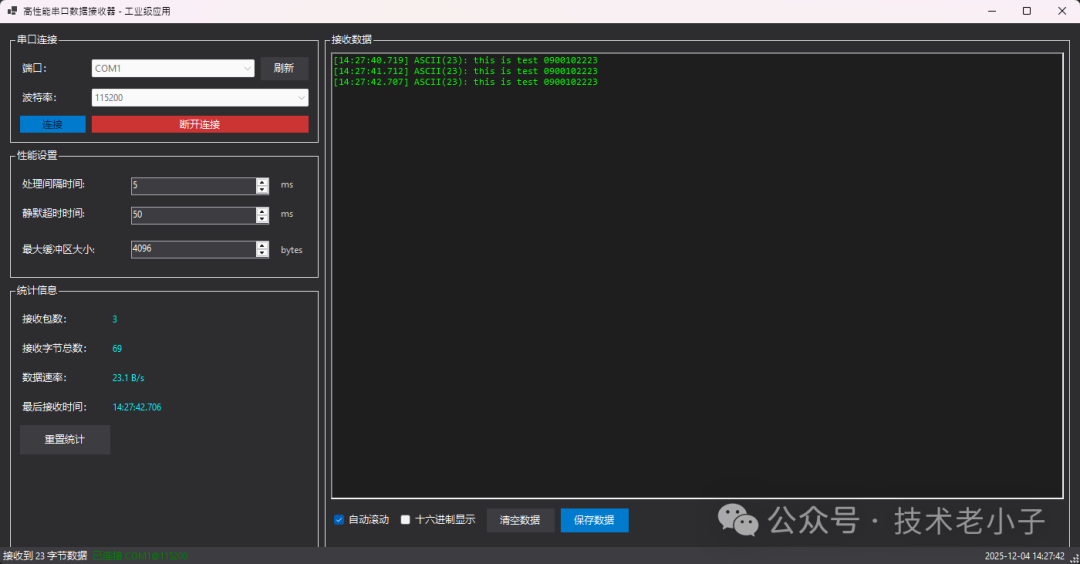
该UI程序运行后,其界面效果图如下,包含了串口连接、参数设置、数据显示与统计等完整功能模块:
性能优化核心技巧总结
实现高性能 串口通信 有几个关键技巧,可以对比传统做法来理解:
1. 数据处理优化:从单字节到批量
避免每接收一个字节就进行复杂处理,这会产生巨大的开销。
// ❌ 传统方式:每字节触发一次事件
serialPort.DataReceived += (s, e) => {
    int data = serialPort.ReadByte();
    ProcessSingleByte((byte)data); // 频繁调用
};

// ✅ 高效方式:批量处理
while (serialPort.BytesToRead > 0)
{
    dataQueue.Enqueue((byte)serialPort.ReadByte());
}
// 后续在另一个线程中异步批量处理队列数据
2. 内存管理优化
3. 线程安全保障
实际应用场景与注意事项
典型应用场景
- 工业自动化:PLC数据采集、设备状态监控、高频质量检测系统。
- 物联网:智能仪表(电表/水表)读数、环境监测站数据收集、车联网终端(GPS/OBD)通信。
常见“坑点”提醒
- 串口资源释放顺序:务必在
Dispose 方法中先关闭串口(停止数据生产),再取消并等待处理任务完成。
- 避免UI线程阻塞:切勿在UI线程中调用可能长时间阻塞的同步
Wait() 方法,应采用带超时的等待或异步模式。
- 数据包边界协议:文中基于静默时间的“智能分包”是一种通用策略,在实际项目中需要根据具体的通信协议(如固定长度、特定头尾标识)进行调整。
- 防范内存泄漏:除了清理UI控件,还要确保事件订阅的取消和托管资源的及时释放。
总结
通过本文的完整实现,我们系统性地解决了传统串口通信在 性能瓶颈、数据分包、资源释放 三个方面的核心痛点。这套基于生产者-消费者模式、结合了无锁队列和智能分包算法的方案,在实际工业项目中表现稳定,能够可靠处理高达921600波特率的连续数据流。
三个最值得借鉴的核心设计点:
- 生产者-消费者模式:实现了数据接收与处理的彻底解耦。
- 智能分包算法:静默时间与缓冲区大小双重判断,提升了数据包解析的准确性。
- 优雅的资源释放:异步Dispose模式避免了UI线程的阻塞,确保了程序退出的顺畅性。
在工业4.0和边缘计算持续发展的背景下,稳定高效的串口通信仍然是连接传统设备与智能系统的关键桥梁。本文分享的 C# 方案,其设计思想也可广泛应用于其他需要处理实时流式数据的场景。如果你在实践中遇到了其他有趣的挑战或优化技巧,欢迎在技术社区进行交流与分享。
 发表于 2026-2-26 06:41:54
|
查看: 514|
回复: 0
发表于 2026-2-26 06:41:54
|
查看: 514|
回复: 0

